My Peace I Give To You; Let Not Your Hearts Be Troubled

6 Sep

As a Christian, there is a kind of peace I experience that is far above and beyond what this world can offer. It is “a peace that passes understanding,” as the apostle Paul would say…and it is mine in Christ. It is the kind of peace that remains even when things aren’t going my way. Ironically, it’s the kind of peace that holds up in the most chaotic of circumstances. It’s a personal peace with God and others that I enjoy because of the Gospel, and I am eternally indebted to God for that.

But what bearing does my personal peace have for your life? Does it matter that I enjoy this very intimate and personal peace? Are there any consequences to not having this person peace?

Piper wrestled with this question in a sermon he recently preached on John 14: 25-31 entitled “My Peace I Give To You; Let Not Your Hearts Be Troubled,” and touched on it again in this sermon. Essentially the answer is this, my personal peace with God affects your life. And so it follows that your personal peace with God affects my life and the lives of those around you.

We see numerous examples of this in Scripture. Think of the Thessalonians. News of their faith in Christ (which subsequently means peace with God) sounded forth and was an encouragement to an entire region of believers. Imagine that. An entire region of Christians simply heard about the faith these other Christians had, and they were encouraged. Even the apostle Paul himself was encouraged by the faith of these believers. And think about young Timothy and how the sincere faith of his mother and grandmother affected his life. Little did these two women know that their personal peace with God would affect generations of Christians to come!

Now, this means that the opposite must be true as well. If we lack personal peace with God we are still going to have an effect on the world around us, only it won’t encourage – rather it will tear down and destroy. You see this clearly in the world around us – terrorism, mass murders, broken families, immorality. All of it is rooted in hearts that do not know the peace of God. People like to pretend that what goes on in a person’s heart really doesn’t matter. But it does. Remember what Jesus said, “For out of the heart come evil thoughts, murder, adultery, sexual immorality, theft, false witness, slander” (Matt. 15:19).

Our personal peace matters, and I would challenge you in particular Christian to strive to enjoy that personal peace with God on a daily basis. Think of how the Lord used the faith of the Thessalonians and of Timothy’s mother and grandmother and be encouraged. Be encouraged to think that God uses us in ways that we can’t even imagine. And at the same time be sobered by the reality of what our lack of peace can accomplish in the lives of those around us.

Call it what it is.

5 Sep

“Woe to those who call evil good and good evil, who put darkness for light and light for darkness, who put bitter for sweet and sweet for bitter!”- Isaiah 5:20

 “For the wrath of God is revealed from heaven against all ungodliness and unrighteousness of men, who by their unrighteousness suppress the truth.” – Romans 1:18


I can’t help but be even more heartbroken than usual at the enthusiastic support for abortion that is making rounds through every media avenue. For those of you who are following the news, the upcoming American election is what’s highlighting the divide between those who are pro-life, and those who are pro-choice. That tweet I shared at the top from an American comedian, Sarah Silverman, reveals a lot about the way that people view this issue, and sheds even more light on the use of language to distort the truth. According to most liberals, if you’re not on the pro-choice side of the abortion debate and supportive of this arm of the women’s liberation movement, then you are in opposition to freedom, to true humanity, to justice. It’s not about the babies; it’s about the women who are having (or not having) them. And it’s not about murder, it’s about RIGHTS.

Doesn’t that term “reproductive rights” sound so persuasive? Pro-choice. The women’s liberation movement. I mean, all of these words sound so positive, so humane, so at the core of all that our society holds to as pillars of progress and forward movement. These are just examples of the kinds of things that we hear from people who take this position:

  • Women should be free to do whatever they want with their own bodies. Who are you to tell me what I can or can’t do with my body?
  • I have rights. I don’t know who gave them to me but I have them and I demand to see them respected and upheld by everyone.
  • Women need to be freed from oppression. For too long society has held them down, subjugating them to the role of wife and mother. Free them!

Here are a few things that Margret Sanger, the founder of Planned Parenthood, today’s premier purveyor of abortions in America, had to say about the issue.

“The most merciful thing that a large family does to one of its infant members is to kill it.” – Women and the New Race 
(Eugenics Publ. Co., 1920, 1923)

 “I think the greatest sin in the world is bringing children into the world – that have disease from their parents, that have no chance in the world to be a human being practically. Delinquents, prisoners, all sorts of things just marked when they’re born. That to me is the greatest sin – that people can – can commit.”

Wow. So it is an act of “mercy” to kill an infant? It is “the greatest sin” to bring diseased children into the world since they have no chance to be human beings? This coming from the mouth of the woman who is responsible for advocating birth control to prevent the world from having unwanted children, and to getting rid of those that were already in the womb but were undesirable. According to Sanger, and sadly to many others today, her definition of sin would be allowing a child to live.

Ok, what about that word sin? I guess that’s what this all comes down to. Not that word alone, but what it represents, as a statement of truth that describes one’s actions as right or wrong, good or evil, righteous or unrighteous, in opposition to God. The thing that people find most offensive about the Bible is not that it lacks clarity and is hard to understand, but that it is perspicuous, never mincing words, always speaking the truth. Every page is filled with those truths that describe clearly what sin is. It tells us who is guilty of sin (everyone). We learn many stories of the consequences of disobedience while looking at the lives of the men and women that fill its pages. Never is there an unclear word or passage where anyone would have trouble determining whether or not killing babies, or committing adultery, are wrong. No sinful action is painted in a positive light to make it seem more acceptable; no words are distorted and twisted to “call good evil and evil good”. It’s blindingly clear, and ultimately, this is what makes it so good. This is the light to our path, and sight to blind eyes. Without God’s kind revealing of what sin is, whom it is we have sinned against, and the remedy for our sin, we would have no hope. As it says in John 8:32, we are only set free once we know what is true. As long as we believe in lies, we are dead, in bondage to sin, under the power of the prince of the age.

This is where I believe Christians need to really become attuned, if they’re not already, to the power of language and the danger of succumbing to our culture’s rhetoric. If we remain ignorant and acquiesce to the climate of the day, then we risk loosing our witness to the watching (and reading or listening) world. We of all people must be clear about what is true and what’s not, and accordingly, we need our words to be shaped by that truth. It is no small thing to fall into the trap of using words such as “reproductive rights” or “women’s liberation” to discuss issues like abortion and feminism. There is a subtle and dangerous agenda that lies behind all of the positive-sounding verbiage that originates from the one who ultimately desires to deceive and destroy. By masking the truth about what people are doing, Satan effectively keeps people from seeing their sin and their need for the Savior. When we use words like “alcoholism” to describe someone who is addicted to alcohol, we can be participating in a very subtle form of transference. A word like “alcoholism” gives the impression that  “It’s not me; it’s a disease that is genetic. I’m predisposed to strong drink; therefore I’m not in control over what I do.” This is a grave danger! For all of us, we must be willing to face, and to help others face the fact that according to Scripture, addiction to alcohol is a result of the fact that we are sinners, not that we inherited a genetic problem or disease for which we then have no accountability. As another example, what about that word “affair”?  It sounds so mysterious, so attractive even. We would be more inclined to hide the truth in a word like “affair” that connotes something much less than what it is, rather than call it adultery or describe the act of illicit sex outside of marriage as a vile, destructive, life-ruining sin.

And back to the abortion issue. What’s at hand is not “women’s rights” or “freedom”, but rather the murder of human life, plain and simple. I’m not suggesting that Christians who understand the issue and realize that abortion is murder are afraid to call it that, but rather, when we refuse to engage people who do believe that the debate centres on rights and the freedom to chose, we are running away from a battle that we must engage in. I am a person who hates to run into a debate. Contrary to what some of you who know me might think, they make me nervous, nauseous even to the point that I’d rather spend the next hour breathing into a paper bag in the privacy of my bathroom than going head on with someone who I know from the outset is bound to disagree, maybe even hate me because of what I believe and what I will say.

In teacher’s college, I had this experience every day. I would get up and walk into a minefield. Thankfully I had a few likeminded friends who kept me from feeling like I was getting completely annihilated, but nonetheless it was exhausting. I knew that each day, some new social issue, moral topic, or political position would be on the table for discussion (or rather a loud shouting match with some of the shouters foaming at the mouth). And each day, I knew that I was going to in some way have to give an answer for the hope that I had. I didn’t end up having many direct discussions in my classroom about my faith, but it did matter what I said, and what I was willing to stand up for when it came to issues that I knew the Bible spoke clearly on. Silence in this case was not an option. Silence would have been a tacit acceptance of everything that was being portrayed as truth, and yet was wickedly false, especially because we were being asked to participate. It was not a lecture, it was interactive. I knew that even if I didn’t succeed in persuading one single person of the rightness of any of the positions I was taking, it didn’t matter. God uses our speaking the truth to bring conviction, and we may never see the result of that. Nonetheless, He requires of us that we not be afraid, but rather we be like Daniel, Shadrach, Mesach and Abednego, not bowing down to the idols of our age, but standing up before the one true God. That is our witness.

So language matters in that we firstly need to be clear about what the Bible says about sin. We need to have a clear understanding of how speaking the truth is part of our witness to those who don’t know Christ. We need to be convinced that there are lies that are being promoted as truth all around us. And we need to ask God for the courage to stand up, when necessary, and speak in love to those around us, not shirking back from difficult, uncomfortable conversations as they come along, but engaging people and being willing to call things what they are. By doing this, we will be salt and light, and by God’s grace, he will use the truth to bring many more people into the light. Only then will they be receivers of true freedom, not the counterfeit kind that is being peddled on every pedestal, political platform, and from within our own deceitful hearts.

Seated on His Throne

31 Aug

“Behold our God, seated on His throne, come let us adore Him”

Last Sunday we sang a song in church, and this line really resonated with me. So many amazing truths are packed in the one statement “God on His throne.” I hope to be able to look at just a few of them, though I definitely won’t be able to cover it all.

We don’t have to watch international news for long to see the effects of a country without a leader. Where some think this would be the ultimate freedom, the result is always widespread chaos, disorder, injustice and ultimately rampant fear. The truth that God is on His throne assures us that this world is never without a Sovereign King. What is more, unlike kings and leaders who are corrupt and not to be trusted, our Sovereign King is righteous, Holy and always good. “Say among the nations ‘The Lord reigns.’ The world is firmly established, it cannot be moved; He will judge the peoples with equity.” Psalm 96:10

The fact that God is on His throne not only comforts me in knowing that He is sovereignly ruling the universe, but as a believer, it means that He holds sole responsibility of ordering and ruling my own personal life. It’s one thing for a leader to run a country…but an entirely different thing to invite this leader into your home, your life, your own soul to order its affairs and manage every detail. But this is what it means to be a Christian. Why is this a comfort? Because we have the promise that “We know that in all things God works for the good of those who love Him, who have been called according to His purpose.” Romans 8:28

If I were in charge of our nation (and thank God that I’m not), I’m pretty sure I’d live with a nagging fear. When will this all be over? How long will it take for people to discover that I’m not as good as I think I am? How long before they are disappointed with me, as they are with all other leaders in their past? In essence, how long before my seat in office come to its end? What’s incredible about the truth of “God on His throne” is thatHis throne will never be occupied by another, nor will His rule ever come to an end. In fact there has never been a time when God was not ruling in power.  For all of eternity past, and all eternity to come, He is firmly established as Sovereign ruler and King.   ”Your kingdom is an everlasting kingdom, and your dominion endures all generations.” Psalm 145:13

When I think of a leader, ruling over the affairs of the country, I picture someone who is completely out of reach of the common people. He or she is tucked away at the end of a long hallway, protected by door after door, guarded by security of course, until finally you reach an inner office where only the few elite are allowed to inhabit. The regular folk, they just a get a view of the outside building from a tour bus. And if you want to talk to the ruler, I mean, I guess you could try calling his direct line. But really, good luck with that! But look at what God’s word says about the Christian’s relationship with our Sovereign King:

“Therefore, brethren, having boldness to enter the Holiest by the blood of Jesus, 20 by a new and living way which He consecrated for us, through the veil, that is, His flesh, 21 and having a High Priest over the house of God, 22 let us draw near with a true heart in full assurance of faith” Hebrews 10:19-22

“Let us therefore come boldly to the throne of grace, that we may obtain mercy and find grace to help in time of need.” Hebrews 4:16

One more thing. It’s obvious that not everyone acknowledges, or even believes in the God of the Bible. Some dismiss Him as a fairy tale and disregard His very existence. But this does not thwart His plans, nor does it interfere with His Sovereign Rule. Unlike human rulers, God does not need to be elected. He sits on His throne because He is God, and nothing will ever change that. And there will come a day when all men will stand before this holy throne, and will be need to give an account for how they have responded to the person and work of Christ. Have they rejected Christ? Or have they turned to Him in faith?  This is the only basis by which all men will be judged.

Are we ready to stand before this throne?


What I’m Reading

27 Aug

Here are a few pieces I enjoyed this past week while perusing the web with a few lines to peak your interest!

When You Need – Rachel Jankovic

“It is incredibly easy to fall into the temptation of keeping a close watch on potential nice things other people could do for you. But do not define yourself as a needer. Define yourself as a giver…We can let go of our self absorption and start giving, every time we have an opportunity (which is many thousands of times in a day) with a thankful heart.  So if you are feeling low, think of what you can give. You can always give a smile, give a cheerful laugh, give a meal with no strings of desperation tied onto it.”

“I’m Tired of Hearing the “Gospel” (Warning: Mild Rant) – Thabiti Anyabwile

It doesn’t matter what the topic is.  Men and women struggling to get along in their marriages?  ”The gospel.”  Someone struggling to find work in this economy?  ”Believe ‘the gospel’.”  The mechanic just “fixed” your car–again–and charged you–again–for the same problem you noticed last week?  Think of “the gospel.”  The Russian high court sentencing a punk rock band to two years in prison for a flash mob performance in a Russian Orthodox cathedral?  ”They need the gospel.”  Want rock hard abs?  Try “gospel” aerobics.  I smashed my little toe against the dresser?  All together now, “the gospel.”

… Of course, I’m not tired of hearing the actual gospel.  Let us all determine to know nothing but Jesus Christ and Him crucified.  But let us also learn that the apostle taught a lot of things about Jesus Christ, His crucifixion and resurrection without lackadaisically tossing out a few cliched references to “the gospel”.

Ten Things About Church You Should Know (But No One Had the Guts to Tell You)– Kevin De Young

1. There are 150 psalms in the Bible. This collection is called the Psalter or simply The Psalms. Each chapter in the book is an individual psalm. So even though we call the book “The Psalms” you’ll want to say “Psalm 23″ instead of “Psalms 23.” As much as we love that chapter, it still only counts for one psalm.

“Feed My Lambs”– Charles Spurgeon

Children in grace have to grow, rising to greater capacity in knowing, being, doing, and feeling, and to greater power from God; therefore above all things they must be fed. They must be well fed or instructed, because they are in danger of having their cravings perversely satisfied with error. Youth is susceptible to evil doctrine. Whether we teach young Christians truth or not, the devil will be sure to teach them error. They will hear of it somehow, even if they are watched by the most careful guardians. The only way to keep chaff out of the child’s little measure is to fill it brimful with good wheat. Oh, that the Spirit of God may help us to do this!

“Neil Armstrong”The Telegraph

Neil Armstrong, the American astronaut, who has died aged 82, cemented a unique place in the history of mankind by becoming the first person to walk on the Moon; though his personal achievement was a product of the Cold War’s bitter technological and political rivalry, the successful completion of his mission proved a transcendent moment that captured the imagination of the entire planet.


A Relaxing Afternoon Nap

24 Aug

It was Sunday afternoon. We were coming home from church and planned to spend a relaxing afternoon at home before heading back for evening service. I was so looking forward to going home, putting on my track pants, and enjoying a nice long nap. It was a perfect opportunity for bonding: Shady with Amanda, and me with my pillow.

But I remembered that we didn’t have anything exciting to have for lunch. I figured it would be harmless to stop and pick up some groceries first…I hadn’t gone grocery shopping in who knows how long, and since Shady was with me to help this was the perfect opportunity.

By the time we got home and lugged in all the groceries, I had really earned my nap. Except that first I just had to put the groceries away. Shady and Amanda were playing on the carpet, and I was resisting the urge to reorganize the entire fridge while putting away the food. Amanda, who now enjoys the freedom of crawling around the entire house, had made her way into the dining room where she discovered the wall vent. I smiled to myself as she began to play it like a guitar. Up and down she stroked her fingers, enjoying the sound it made.

It seemed like a good idea at the time.

Moments later I glanced over to find that while exercising her musical abilities on the wall vent, she had somehow cut her finger. There was blood everywhere. And I do mean everywhere! Blood on the vent, on the floor, her dress, her legs, her face. Even her ears. All from one tiny cut on her finger that she wasn’t even aware of.

I panicked. And then I did the most logical thing I could think of.

“Shaaaaaddddyyyy!!!”

As Shady rushed over to clean up the war zone, I rushed Amanda upstairs to find some bandaids and stop the bleading. The next half hour could have been an infomercial for why every parent should take a first aid course. Countless baby wipes…numerous discarded bandaids that were far too large for her tiny finger….blood spilling on the carpet, on Amanda, on me.  I had no idea how to treat this tiny little cut that was producing far more blood than I ever thought possible. I think it was around that time that Amanda clued in that something was wrong. And that’s when she started crying. Actually crying isn’t the right word…screeching is more like it.

Shady came upstairs to my rescue and we sat with her on the bathroom floor… which had now been transformed into an operating room…throwing ideas around of how we can stop the bleeding and get her to calm down.

Half an hour later, with a make shift cast that was far too big for her finger, and Amanda’s dress soaking in dish soap in the bathroom sink, Shady and I leaned against the wall on the bedroom floor. Amanda looked at us with an expression that said “you really didn’t handle that very well.” We resolved that vents were a bad idea and that we really needed to invest in children’s bandaids.

Back downstairs to resume the original task of putting the groceries away. Of course by then the interesting lunch I had planned (which now fell into the category of an early dinner) seemed largely disappointing. And in the chaos of it all I had completely forgotten to feed Amanda (another proud moment for me). So we ate. And she ate….and you guessed it….it was soon time to drive back to church for evening service. Needless to say (though I’ll say it anyways) I didn’t have my nap.

When I envision a mother who is to be admired, this scene is not what comes to mind. But I did learn some important lessons from the fiasco with the heating vent. I learned that I really need to be flexible. Just because I have an idea of how my afternoon is going to be spent, doesn’t mean that’s what I’ll actually get to enjoy. I can have a bad attitude about it, or I can embrace it and make the best of it. And for future reference, reflecting on what went wrong and who should have done what differently is important…but not while the baby is panicking and crying.  In fact as a general rule try to avoid having any kind of meaningful conversation while a baby is crying….chances are it won’t go well. And most importantly…when I’m tempted to think I’m an amazing mother who has it all together, remember these moments to keep me humble.

It’s times like these that Shady and I can look back on and laugh at our inexperience. Perhaps God does allow them to humble us, show us how much we need Him in every moment, and how important it is for Shady and I to be united as we learn how to be parents…together.


Why Being Progressive Isn’t Always a Good Thing

20 Aug

It’s very “au courant” to be progressive. When that word progressive is used today, it has the connotation, to most, of someone or something that is “with the times” and has left behind old, out-dated notions. If you’re a progressive, you’re modern, you’re interested in  reform, you hold to new, liberal ideas.

But being progressive isn’t always a good thing, especially when it comes to Scripture. There are and have always been shifts throughout Christian history, where a person or group began to advocate teaching that seemed to “progress” beyond orthodox Christian beliefs. By orthodox, I’m not referring to the Orthodox church, but rather, I mean truths that have been universally accepted by Christians since the time of Jesus. Diverging. Moving away. To diverge and move away would be good things, if the teaching that was being supported was untrue or harmful. But when moving away and diverging from the truth is what’s taking place, you’re in a dangerous place. Today, movements within Christianity such as the emergent church, and the prosperity gospel  are good examples of false teaching that has and continues to lead many people astray. Being led astray is no small thing, when the matter at hand is one of life and death.

In Matthew 7:15-20 Jesus says “Beware of false prophets, who come to you in sheep’s clothing but inwardly are ravenous wolves. You will recognize them by their fruits. Are grapes gathered from thornbushes, or figs from thistles? So, every healthy tree bears good fruit, but the diseased tree bears bad fruit. A healthy tree cannot bear bad fruit, nor can a diseased tree bear good fruit. Every tree that does not bear good fruit is cut down and thrown into the fire. Thus you will recognize them by their fruits.” Those who do not bear fruit, or do not display the marks of true disciples, will be proved in the end to be false. And those who are not true disciples, as the Bible says, will spend eternity apart from God, in hell. That is a grim reality for anyone who has believed a false teacher and who has followed their teaching. Therefore, leaving behind or straying from what is true and following what is false is of mortal danger to the soul.

Last week, I came across this powerful sermon from John Piper and wanted to share the link with you. He makes six points from 2 Timothy 3:14-17 on why we must continue on in the truth found in Scripture. Here is a short summary of the main points, but I hope you’ll be willing to take a listen (or 3- I had to in order to soak up as much as I could, and I’ll probably listen again!) and study this passage as a reminder, or introduction, on why we must not leave the Scriptures and “progress” to new, different, au courant teachings.

2 Timothy 3:14–17,

But as for you, continue in what you have learned and have firmly believed, knowing from whom you learned it 15 and how from childhood you have been acquainted with the sacred writings, which are able to make you wise for salvation through faith in Christ Jesus. 16 All Scripture is breathed out by God and profitable for teaching, for reproof, for correction, and for training in righteousness, 17 that the man of God may be complete, equipped for every good work

1. The character of the people who taught you the truth (verse 14b).

– Don’t forget the testimony of those who taught you the truth. Part of our confidence in the faith is in the credibility of the witness of those who were influential in leading us to Christ.

2. The marks of divine holiness in the Scriptures (verse 15a).

– “Just as God’s holiness is his utter uniqueness, so the Scriptures share in that holiness and have their own self-authenticating unique traits. So, Timothy, stay in what you’ve learned, because these writings are holy, they bear the distinguishing marks of the one and only God. Don’t turn away from them. Ask God to give you eyes.”

3. The power of Scripture to save sinners (verse 15b).

– “The Scriptures are uniquely suited to subdue folly and impart wisdom which can then see reality and embrace saving truth.”

4. The Scriptures brought you to Christ  (verse 15c).

– “The Scriptures prepared your mind and heart to see Jesus for who he is and to believe in him. Don’t walk away from the writings that brought you to Christ.”

5. The Scriptures are God-breathed (verse 16).

– “God’s influence was not simply on the mind of the writers in general, but his attention to the process of Scripture creation was such that when their minds and hands  composed actual Scripture words, these words were so much God’s words that Paul says the writings themselves are God-breathed.”

6. Finally, the Scripture is profitable—inestimably profitable (verses 16–17).

– “The God-breathed Bible aims to make us godly. To make us doers of good in this world. Don’t miss that. The doctrines of the Bible are designed to produce deeds. Good deeds. And they do it by teaching, verse 16, and that teaching has three sequential effects: Reproof, correction, and training in righteousness.”

Thoughts on Marriage

17 Aug

This week Shady and I celebrated our wedding anniversary! What a wonderful opportunity to stop and reflect on all the ways in which God has truly blessed me and moulded my character through this most precious and treasured relationship. I  know that it’s only been four years, and in many ways we are still “children” when it comes to marriage expertise. But I would love if I could share some of the lessons God has been teaching me about the marriage relationship.

  • Being a humble listener: I’ve discovered that I’m a prideful listener. It was my mother who gently pointed out to me that often times when I listen, it is as though I am standing ready to find fault in the other person’s opinion and defend my own.  Just yesterday Shady offered a suggestion regarding an area I could make a slight change. Rather than absorb the suggestion with humility, I immediately became defensive. It was later that I realized he was right, and the only thing that prevented me from agreeing at that moment was my pride. Humble listening allows us to learn from the other’s knowledge and wisdom, take correction, and sharpen each other’s characters.
  • Make an effort to make conversation: That’s it? That’s the suggestion? I know, it’s very simple, but often times very difficult to apply. Take for example the end of the day. After making dinner, cleaning up, feeding Amanda, cleaning up, giving her a bath, giving her the bottle, putting her to sleep…all I want to do is lie on the couch and enjoy not speaking. But the truth is, that may be the only time that we’ve had alone all day.  It’s important for me to make the effort to ask about his day, talk about the things that are going on with him, and share the things that I am thinking and feeling as well. Silence is easier. And of course necessary at times. But if I’m lazy in my conversations, then I could find that days go by where I haven’t made an effort to connect.
  • Don’t just talk about me: I could go on about me for days (Perhaps you can relate). What I think. How I feel. What I want. What I need. What I like. What I hate. Me me me. The marriage relationship demands that I step out of just talking about me, and focus on him. How does he feel, what does he need, what are his concerns? If we’re both concerned with the other person, then both of us will be taken care of!
  • Don’t do things for recognition: It’s happened several times in our relationship, and each time the result is the same. If I do something for the sole purpose of getting appreciation and thanks, and he doesn’t even notice, I’ll get upset. Fine, I’ll get mad. Like if I clean the whole house just so that he says “wow, you work so hard….in fact I’ve never seen anyone who cleans a house like you,” chances are he may not respond that way, may not give me the appreciation in the way that I want…and I’ll be disappointed. I know it’s difficult, but I need to learn to do things for the sake of blessing him and making him happy, and not just for the thanks and praise I’ll get in return.
  • Surround yourself with godly marriages: Find couples who are older than you, who demonstrate godly principles in their marriage. Spend time with them, ask their advice, learn from their example. We recently had an opportunity to spend a Saturday afternoon with one of the older couples at our church. They blessed us by asking how we were doing in our marriage, how our walk with the Lord was, and encouraged us with their godly council. Rather than only filling your time with friends who are your own age, consider investing in these kind of relationships that can really prove to be a source of encouragement and growth.
  • Bless your children: I can’t remember who it was that told me this, but I once heard that one of the greatest gifts I can give to Amanda is to love her father. The tendency is to make our children the first and greatest priority in our lives…andfor our husbands to take a distant second. And society may even applaud that as “sacrificial love” and claim that’s the heart of a mother. But that’s backwards. For a wife, the most important human relationship ought to be with her husband, and for the husband the same should be said for his wife. When this relationship is in its proper place, then our children will be loved, cared for, and treasured as they ought to.

So much more has been learned…praying and reading the word together, making God the centre, being sacrificial and forgiving in the midst of an argument….Is one blog really enough? Ultimately, I am left thinking, how can my marriage be a growing testimony to the powerful truth of the Gospel?

Again, I know I’m not an expert. In fact if you want expert advice on marriage, turn to God’s word. What a treasure of wisdom on the marriage relationship!

So Happy Anniversary to me…and happy Friday to all of us!

Mining for Gems

13 Aug

My dad was once describing the way that Charles Spurgeon’s writing had impacted him by saying that it was as if he (Spurgeon) were a miner that was always digging for and producing  beautiful jewels as he unfolded the word of God, and that Spurgeon had this way with words that could make a reader understand things from so many different angles and see different aspects of the beauty of a thing in the same way a diamond shines and reflects light from so many different views. I was intrigued and so, I began to peruse Spurgeon’s writing occasionally. A great resource my dad linked me to was Phil Johnson’s website www.spurgeon.org, where you can find what I think is the largest online collection of his works. One of my favourites has been his daily devotional called Morning and Evening. I use it almost every day and can’t bookmark enough of the sentences and truths he makes clear to my mind. What a gift- to be able to write with precision and clarity. That’s definitely a talent I haven’t honed, but one that I think is so valuable and worth cultivating, not for the writer’s sake, but for the sake of those who read. We swim in muddy waters every day, where ideas are presented to us at lightning speed, and persuasive but subtle arguments of all kinds are influencing our thoughts. How important for a Christian to be clear, to be pointed, to be persuasive in all the right ways! So much is at stake and it matters that the words we write (and speak for that matter), not be wasted. This is a lesson to self that I am and will for a long time be learning.

Enough said. I’ll point you to Spurgeon this morning to start off your day with his clear insight into Psalm 104:16. If you haven’t already become familiar with who Charles Spurgeon is, you need to head over to www.spurgeon.org and read some of his writings and sermons and take a look at his biography. He wasn’t called the Prince of Preachers for no reason!

“The cedars of Lebanon which He hath planted.”—Psalm 104:16.

EBANON’S cedars are emblematic of the Christian, in that they owe their planting entirely to the Lord. This is quite true of every child of God. He is not man-planted, nor self-planted, but God-planted. The mysterious hand of the divine Spirit dropped the living seed into a heart which He had Himself prepared for its reception. Every true heir of heaven owns the great Husbandman as his planter. Moreover, the cedars of Lebanon are not dependent upon man for their watering; they stand on the lofty rock, unmoistened by human irrigation; and yet our heavenly Father supplieth them. Thus it is with the Christian who has learned to live by faith. He is independent of man, even in temporal things; for his continued maintenance he looks to the Lord his God, and to Him alone. The dew of heaven is his portion, and the God of heaven is his fountain. Again, the cedars of Lebanon are not protected by any mortal power. They owe nothing to man for their preservation from stormy wind and tempest. They are God’s trees, kept and preserved by Him, and by Him alone. It is precisely the same with the Christian. He is not a hot-house plant, sheltered from temptation; he stands in the most exposed position; he has no shelter, no protection, except this, that the broad wings of the eternal God always cover the cedars which He Himself has planted. Like cedars, believers are full of sap having vitality enough to be ever green, even amid winter’s snows. Lastly, the flourishing and majestic condition of the cedar is to the praise of God only. The Lord, even the Lord alone hath been everything unto the cedars, and, therefore David very sweetly puts it in one of the psalms, “Praise ye the Lord, fruitful trees and all cedars.” In the believer there is nothing that can magnify man; he is planted, nourished, and protected by the Lord’s own hand, and to Him let all the glory be ascribed.
Why So Afraid?

10 Aug

In the year 2002 I travelled to Costa Rica with one of my good friends Sherien. We loved to travel together on several occassions, mainly because our travelling styles were so similar. We would enjoy hours and hours of talking and talking and talking…but also gave each other lots of alone time to do our own thing.

On one particular afternoon I was enjoying some of this alone time. I had walked down to the beach, which was quite a hike from the hotel, and found a pier of rocks that travelled pretty far into the water.  I stood at the end of the pier and relished in being far away from everyone and everything. I stood, soaking in the sun, loving the fact that I was all alone. At least that’s what I thought.

When I turned around to return to shore I discovered I had an audience..two ferocious looking dogs who stood side by side…staring at me. I froze. My heart was gripped with fear. There really wasn’t anywhere for me to go ….though looking back I wonder why I didn’t just jump into the ocean. And so I decided the best thing to do was begin a slow and steady walk back to shore, right passed them, praying that they would have no interest in coming after me. I cannot tell you how I felt inside.

I’ll spoil the ending and tell you that nothing happened. I lived to tell about it.

Have you ever been in a similar situation where fear took over your entire body? Leaving you paralyzed, shocked, almost incapable of thinking, fear has a way of completely consuming us.

Lately I’ve found myself really having to battle fears…most of them irrational or completely unnecessary. Like the other night, after putting Amanda to bed I went downstairs to wait for shady to come home. And I was so afraid. What was I afraid of? Not entirely sure, but that didn’t make the fear less real or easy to endure.  Without any warning at all, fear crept in on me as it often does.

In fact I often fall prey to my fears, many of them springing from two of my least favorite words:  “what if?”

  • What if Shady doesn’t make it home safely?
  • What if something happens to Amanda when I’m not looking
  • What if a horrible war breaks out in our country?
  • What if I get sick?
  • What if shady discovers how annoying I actually am??!!!

My problem with these what if questions is that I often go from “what if” to “It now is”. Within a matter of seconds my fear becomes a reality in my head, and I’m left struggling with a fear that completely blinds me from the God who is my all wise and Sovereign Lord.

The Bible has a lot to say about fear.  And much like everything else it has to say, it’s message is completely contrary to what the world has to say.

The world tells us that we need to look within ourselves for strength. No one can help me but me. But the Bible says “The LORD is my light and my salvation– whom shall I fear? The LORD is the stronghold of my life– of whom shall I be afraid?” Psalm 27:1

The world tells us that as long as nothing bad is actually happening that there is no reason to be afraid. But the Bible says that even though something bad or difficult is happening, there is still no room for fear. “Though I walk through the valley of the shadow of death, I will fear no evil, for you are with me; your rod and your staff they comfort me.” Psalm 23:4

The world says that the only thing we have to fear is fear itself. The Bible says that there is something to fear: the wrath of God for our sin. But that the believer’s punishment for sin has been paid for in the cross, and that through the resurrection of Christ the fear of the grave has been defeated. “Death has been swallowed up in victory. O death, where is your victory! O death, where is your sting!” 1 Corinthians 15:55

I know these verses. When I read them I think “Good verse, I already knew it, but it’s a good reminder.” But it’s not important to just know the verse, it’s important to believe the verse to the point of living it out. It’s important to build my life on these truths and stand firm on them when fear enters in. And when my mind begins to travel into the arena of “what if” questions, I need to spend my time dwelling on these truths, rather than dwelling on all the things that cause my heart to fear.

I don’t think I’m alone in this battle with fear. In fact I’m pretty confident that all of us endure the same thing. The cause for fear may be different, but we definitely share the reality of it in our lives. So as believers, let’s encourage each other with the truth of these words. Sow them into each other’s lives. When we share the things that are troubling our hearts, rather than say “Wow, that sounds difficult, I’m sure you’ll be fine,” let’s point each other to the only anchor and rock for our souls…the Word of God.

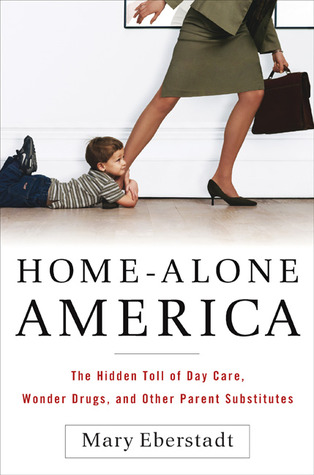
Home-Alone America: The Hidden Toll of Day Care, Behavioral Drugs, and Other Parent Substitutes

6 Aug

“The argument of the pages that follow could scarcely be more controversial to many contemporary readers. Of all the explosive subjects in America today, none is as cordoned off, as surrounded by rhetorical land mines, a s the question of whether and just how much children need their parents- especially their mothers.” says author Mary Eberstadt in the introduction to her book Home Alone America. She explains the drive behind the message of the book by saying that, “It strives to shed light on one of the fundamental changes of our time: the ongoing, massive, and historically unprecedented experiment in family-child separation in which the United States and most other advanced societies are now engaged.”

A while back, I shared some of the books I’ve been reading and I purposely left out “Home-Alone America: The Hidden Toll of Day Care, Behavioral Drugs, and Other Parent Substitutes” in order to devote an entire post to briefly recommending it. I think the title itself is fairly provocative and would probably put some people off of even opening the flap! If you’re one of those people, I hope you at least read this post in its entirety to take a glimpse at some of the compelling points the author makes. I would put this book in the category of highly recommended reading for any parent, parent-to-be, or anyone who works with children. For anyone else who doesn’t fit in those categories, you may very likely become a parent in years to come so don’t forget about this book!

The inside jacket reads as follows: “It might be the most taboo question in America: What do today’s unprecedented numbers of absent parents really mean for children? Why are record numbers of children and teenagers now diagnosed with psychiatric problems of all kinds: conduct disorders, depression, anxiety, ADD?… Why are teenagers contracting herpes and other sexually transmitted diseases, including incurable and cancer-related viruses, at alarming rates? A few decades ago, most children came home from school to a mother who monitored their diets, prevented sexual activity or delinquency by her mere presence, and provided a basic emotional safety net… But today, many mothers work outside the home and many fathers are unmarried or divorced and living far away. Moreover, many children do not have a grandparent or even a sibling nearby to fill the void left by absent parents. As a result, too many kids now feel like just another chore to be outsourced- dropped off at a day care, handed over to a nanny, left in front of a television or the internet, or often sequestered home alone with easy access to all kinds of trouble.”

Eberstardt is right. It is still a taboo question to ask what absent parents really mean for children. From the start, in her first chapter called The Real Trouble with Day Care, she makes a point to clarify that day care is a necessity for some parents. I agree. The point of her argument is not to assess the reasons why parents choose to place their children in day care, but rather to focus on the impact that day care has on many children. Likewise with subsequent chapters on behavioural drugs, music, child obesity, and teenage sex, her goal in asking questions and providing facts and assertions about the cause of problems in each regard is not to denounce behavioural drugs, dietary choices, and music but to try to break in to a debate that has raged on for quite a while, and “challenge that social prohibition”.

To whet the appetite for what Eberstadt has to say, here is a short excerpt from her first chapter on day care.

“Generally speaking, then, both the critics and advocates of institutional care agree about one thing: It is the effects, whether behavioural or cognitive or other, that make or break the case for day care. This emphasis on the long run is only natural, of course; parents do indeed care very much about results of all kinds. In fact, as the ones most likely to have the long-term interests of the child at heart, parents by definition must care about such things; it would be perverse if they did not.

Yet this focus on the long term, natural as it may be, has also obscured one important related point: To say that day care should be judged on the long-term results is not to say that those results are the only measure by which to judge this experiment. Here, as in other serious arguments, ends aren’t everything. The question of what happens in the here and now also needs to be factored in.” (Eberstadt, 3)

If you’d like a little more on why this book is worth a read, take a look at Al Mohler’s review and strong endorsement.

Regardless of the choices you have made or plan on making, her arguments are sure to raise points that you most probably have never thought of or even been made aware of. For that reason, as a person who cares about the well-being of their children, or any children in your life for that matter, I would strongly encourage you to pick up a copy and think through these major issues seriously.

If you’ve read other related literature, I’d love to hear suggestions!